SLA Alerts: The One Feature Your Phone System Is Missing
Most businesses have SLA commitments and no way to know if they're meeting them. Here's why real-time alerting changes everything.
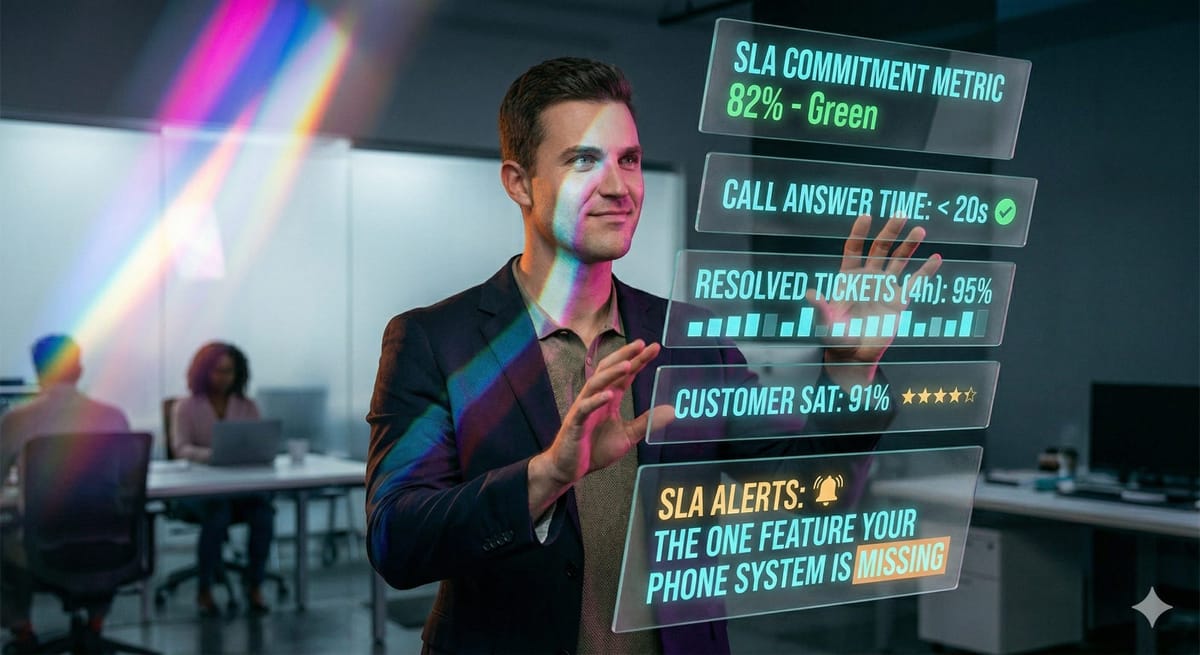
Most businesses have SLA commitments in their contracts. Eighty percent of calls answered within 20 seconds. All escalated tickets resolved within 4 hours. Ninety percent customer satisfaction score. You signed the paper. You made the promise. And then you went back to running your business without any way to know if you're actually keeping it.
This is the SLA paradox: businesses agree to service commitments they can't measure in real time. The customer holds them to it. The business has no idea whether they're winning or losing until the contract renewal — when it's too late to fix anything.
What an SLA alert actually is
An SLA alert is a real-time notification that fires when your service levels are at risk of breaching a commitment. It's not a report. It's not a dashboard you check at the end of the day. It's a signal, sent at the moment when intervention can still change the outcome.
For example: your SLA says 80% of calls must be answered within 20 seconds. An SLA alert fires when your current answer rate drops to 72% — while there are still 40 callers in the queue and agents are handling one call at a time. You get the alert, you add a backup agent to the queue, you bring the number back up before the SLA clock runs out.
Without the alert, you find out at 5pm when the daily report shows you hit 68% for the day. The SLA is already breached. The customer is already unhappy. The damage is already done.
Why most phone systems don't have this
Enterprise call center software has had SLA alerting for decades. It's a standard feature in Avaya, Genesys, and Five9 deployments. The problem is that enterprise software requires dedicated infrastructure, professional installation, and ongoing admin support. For a small business with 5 to 20 agents, the cost and complexity of an enterprise platform is never justified.
So small businesses use consumer-grade VoIP or basic call center tools that track nothing, alert to nothing, and give you a bill at the end of the month with no performance data. They fly blind and hope they're doing okay.
What SLA alerts actually change
The first week with SLA alerts changes how teams behave. When agents know someone is watching the queue — and that missing an SLA has a visible consequence — the urgency is different. Agents take shorter breaks. They pick up calls faster. They stay on task.
This isn't micromanagement. It's context. The same agent who takes a 7-minute break when the queue is quiet will take a 2-minute break when they see the SLA dashboard going yellow. They respond to the data because the data is in front of them.
InsightPBX SLA Alerts
InsightPBX includes real-time SLA alerting out of the box. Configure your service level thresholds — answer speed, queue depth, missed calls — and receive alerts the moment you're trending toward a breach. Alerts can be sent to a manager's phone via push notification, SMS, or email, or posted to a Slack channel for the whole team to see.
Every missed SLA alert is a customer you might not get back. InsightPBX makes sure you're never caught off guard.